


Blog
Unraveling the IRCTC Scam: Lalu Prasad Yadav, Rabri Devi, and Tejashwi Yadav’s Alleged Role in India’s Railway Corruption Saga

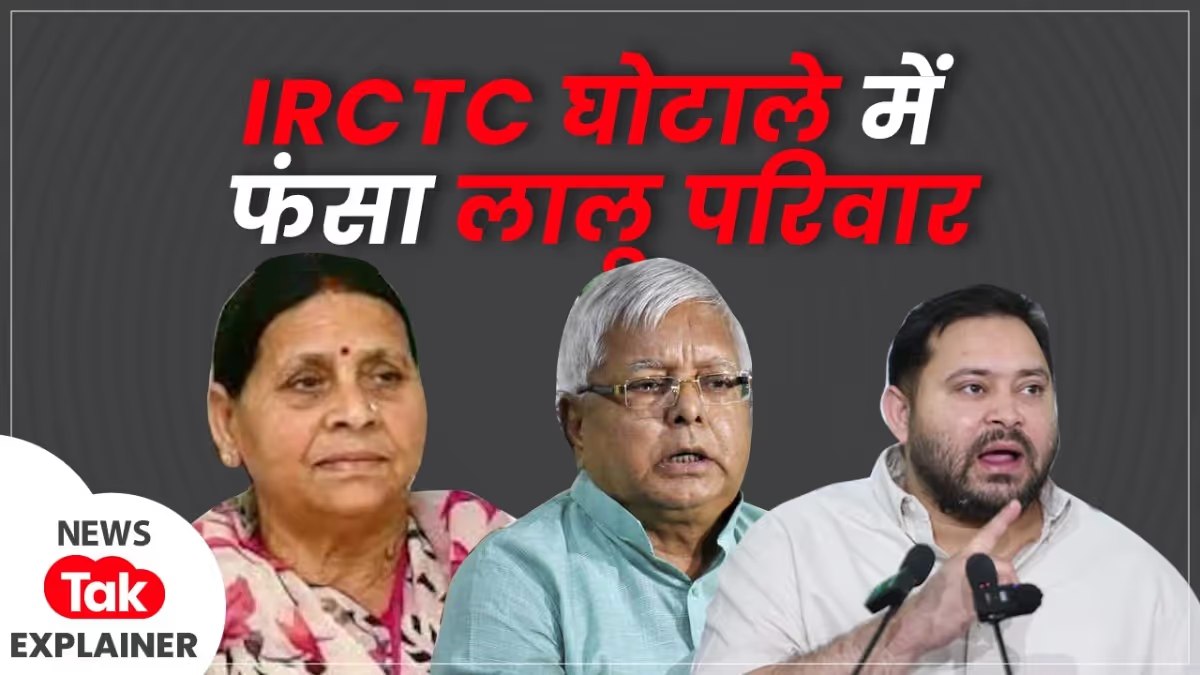
In the labyrinth of Indian political scandals, few cases have gripped the nation like the IRCTC scam. Allegations of corruption, criminal conspiracy, and abuse of power during Lalu Prasad Yadav’s tenure as Union Railway Minister have cast a long shadow over the Rashtriya Janata Dal (RJD) family dynasty.
With charges recently framed against Lalu Prasad Yadav, his wife Rabri Devi, and son Tejashwi Yadav in a Delhi court, the spotlight returns to this multi-crore fraud involving hotel contracts and prime land deals. As Bihar gears up for the 2025 Assembly elections, this scandal—often intertwined with the broader “land-for-jobs” controversy—raises questions about accountability, political legacy, and the cost of public office. This comprehensive article delves deep into the IRCTC scam, exploring its origins, key players, legal twists, and enduring impact on Indian politics.
The Genesis of the IRCTC Scam: A Timeline of Alleged Irregularities (2004-2009)
The IRCTC scam traces its roots to the United Progressive Alliance (UPA) government’s first term, when Lalu Prasad Yadav served as Union Railway Minister from 2004 to 2009. During this period, the Indian Railway Catering and Tourism Corporation (IRCTC),
a public sector undertaking under the Ministry of Railways, was tasked with managing railway hotels and tourism services. What began as routine tender processes for hotel maintenance allegedly morphed into a web of favoritism and quid pro quo arrangements.
The core allegation revolves around the awarding of contracts for two prestigious Bengal Nagpur Railway (BNR) hotels in Ranchi (Jharkhand) and Puri (Odisha). These heritage properties, owned by Indian Railways, were leased to a private entity,
Sujata Hotels—a company owned by the Kochhar brothers, Vijay and Vinay Kochhar—for operation and maintenance. According to the Central Bureau of Investigation (CBI), the tenders were manipulated to favor Sujata Hotels, bypassing competitive bidding norms and undervaluing the contracts.
In exchange, the CBI claims, Lalu Prasad Yadav and his family received valuable land parcels in Patna, Bihar’s capital. Specifically, 3.58 acres of prime land—valued at over Rs 45 crore at market rates—was transferred to a benami (proxy) company linked to the Yadavs.
This company, initially named Delight Marketing Company and later renamed Lara Projects LLP, was allegedly controlled by Lalu’s associates. The land was acquired for a mere Rs 1.5 crore, far below its circle rate, causing a massive loss to the public exchequer.

Key events in the timeline include:
- 2004-2005: Lalu Prasad Yadav assumes charge as Railway Minister. Tenders for Ranchi and Puri hotels are floated.
- 2005-2006: Sujata Hotels secures the contracts through alleged irregularities, including oral interventions from Lalu to expedite approvals.
- 2007-2008: Land transfers begin, with parcels in Patna’s high-value areas like Saguna More gifted or sold at undervalued prices.
- 2010-2014: Effective control of the land shifts to Rabri Devi and Tejashwi Yadav, post-Lalu’s tenure, via share transfers in the benami firm.
This period wasn’t isolated; it overlapped with broader railway recruitment irregularities, blurring lines with the “land-for-jobs” scam, where appointments in Group D posts were allegedly traded for land donations.
Key Accused: Lalu Prasad Yadav’s Family at the Center of the Storm
No discussion of the IRCTC scam is complete without examining the roles of its primary accused: Lalu Prasad Yadav, Rabri Devi, and Tejashwi Yadav. As the patriarch of Bihar’s influential Yadav family and RJD founder, Lalu’s political career
from Bihar Chief Minister (1990-1997) to Union Minister—has been marred by over a dozen corruption cases, including the infamous fodder scam convictions.
Lalu Prasad Yadav: The Alleged Mastermind and Railway Minister
Lalu Prasad Yadav, now 77, is portrayed by the CBI as the “fountainhead of the conspiracy.” As Railway Minister, he allegedly abused his position to influence IRCTC officials,
including then-Managing Director P.K. Goel and Group General Managers V.K. Asthana and R.K. Goyal. Court documents reveal that Lalu intervened orally on at least two occasions to fast-track the hotel leases, ensuring Sujata Hotels’ victory despite lacking the requisite experience.
The Prevention of Corruption Act (PC Act) charges against Lalu include criminal misconduct as a public servant (Section 13(1)(d)) and conspiracy (Section 120B IPC). The CBI argues that these actions led to wrongful losses exceeding Rs 40 crore to the exchequer, while personally enriching the Yadavs through land grabs.
Lalu has denied all charges, calling them “politically motivated” by the BJP-led NDA, but the court’s October 13, 2025, order found prima facie evidence sufficient for trial.
Rabri Devi: From Chief Minister to Alleged Beneficiary
Rabri Devi, Lalu’s wife and Bihar’s Chief Minister from 1997 to 2005, is accused of being a key beneficiary. Post-2010, land parcels were transferred to her name, allegedly as part of the family’s strategy to launder ill-gotten gains. The Enforcement Directorate (ED) has linked her to shell companies like AK Infosystems Pvt Ltd,
which facilitated undervalued property deals. Rabri faces charges of criminal conspiracy (Section 120B IPC) and cheating (Section 420 IPC). Her involvement underscores a pattern in the Yadav family’s asset accumulation, where political power allegedly translated into real estate empires.
Tejashwi Yadav: The Heir Apparent’s Shadowed Legacy
At 36, Tejashwi Prasad Yadav—RJD leader, former Deputy Chief Minister of Bihar, and current Leader of Opposition—represents the family’s next generation. Named in the FIR since 2017, he allegedly received shares in Lara Projects between 2010 and 2014, consolidating family control over the scam-tainted land. Like his mother,
Tejashwi faces conspiracy and cheating charges. Critics argue his rapid political rise—from cricketer to power broker—mirrors the family’s alleged modus operandi of blending influence with illicit gains. Tejashwi has vowed to fight the case in court, dismissing it as “vendetta politics” ahead of the Bihar polls.
Other accused include the Kochhar brothers, IRCTC officials, and associates like former Union Minister Prem Chand Gupta, totaling 14 individuals charged in the case.
Legal Proceedings: From FIR to Charges Framed – A Decade-Long Battle
The IRCTC scam’s judicial journey began in earnest in 2017, amid a surge in CBI probes under the Modi government. On July 5, 2017, the CBI filed an FIR against Lalu, Rabri, Tejashwi, and others, invoking IPC sections for conspiracy and cheating alongside PC Act provisions. Raids uncovered documents linking the land deals to hotel contracts, with the ED filing a parallel money laundering case under the Prevention of Money Laundering Act (PMLA).
- April 2018: CBI files chargesheet against 15 accused, detailing the quid pro quo.
- March 2023: Delhi court grants bail to Lalu, Rabri, and others, citing health grounds.
- March 1, 2025: CBI concludes arguments on framing charges; court reserves order on May 29, 2025.
- October 13, 2025: Special Judge Vishal Gogne at Rouse Avenue Court frames charges. All accused plead not guilty; trial evidence to begin October 27, 2025.
The court’s 2025 order emphasized Lalu’s “prima facie intervention” and the family’s “conspiracy to transfer effective control” of lands. The ED has attached properties worth Rs 6 crore linked to the case, while appeals loom in higher courts. This timing—weeks before Bihar elections—has fueled accusations of electoral interference from RJD quarters.
Interconnections with the Land-for-Jobs Scam: A Broader Pattern of Railway Corruption
While the IRCTC scam focuses on hotel tenders, it shares DNA with the “land-for-jobs” scandal, another CBI probe from Lalu’s railway era. Here, over 100 candidates from Patna allegedly secured Group D railway jobs (2004-2009) without advertisements, in exchange for transferring land parcels—totaling over 1 lakh sq ft—to Yadav family entities at 1/4th to 1/5th market value.
The ED’s 2024 supplementary chargesheet accuses Lalu, Rabri, daughters Misa Bharti and Hema Yadav, and associates of money laundering worth Rs 600 crore. Witnesses, including illiterate appointees, testified to pressure from Lalu’s office. Bhola Yadav, Lalu’s aide, was arrested as a key facilitator. In June 2025, CBI revealed how even those unable to write their names got jobs, gifting lands adjacent to Yadav holdings in Mahua Bagh, Patna.
This dual scam narrative paints a picture of systemic graft: hotels for land, jobs for land, all funneled through benami firms like AB Exports and Delight Properties. Lalu’s family controls assets worth hundreds of crores, per ED estimates, dwarfing their declared incomes.
Political Repercussions: Impact on Bihar Elections 2025 and RJD’s Future
As Bihar’s November 2025 polls approach, the IRCTC chargesheet is a body blow to RJD’s Mahagathbandhan alliance with Nitish Kumar’s JD(U) and Congress. Tejashwi, RJD’s poll face, campaigns on “jungle raj” reversal, but the scam revives memories of 1990s Bihar—lawlessness, fodder scams, and economic stagnation under Lalu-Rabri rule.
BJP leaders like Sushil Kumar Modi and Sudhanshu Trivedi have weaponized the verdict, labeling the Yadavs a “franchise of caste, corruption, and chaos.” RJD counters with claims of BJP’s “misuse of agencies,” but voter sentiment on X (formerly Twitter) shows growing skepticism. Posts from BJP handles like @BJP4India highlight the scam’s “30-second explainer,” while fact-checkers like @NewsmeterFacts debunk RJD’s “false charges” narrative.
Analysts predict a 5-10% swing against RJD in Yadav-Muslim strongholds, potentially fracturing the alliance. Lalu’s health—post-kidney transplant—and Tejashwi’s youth offer resilience, but conviction risks could bar them from contests under the Representation of the People Act.
Public Reaction and Social Media Storm: Voices from X and Beyond
The October 13 verdict ignited X, with #IRCTCSca m trending alongside #BiharElections2025. BJP’s @SudhanshuTrivedi mocked Lalu’s “poor leader, rich family” paradox, while @thehawkeyex decried the Yadavs’ “millionaire” status amid Bihar’s poverty. RJD supporters like @ursadityajha questioned alliance loyalty, asking, “How can people trust looters?”
Fact-checks clarified Nitish Kumar’s defense as overstated, emphasizing CBI evidence. Videos from @TimesNow and @NDTV dissected the scam, amassing millions of views. Public discourse reflects fatigue with dynastic politics, echoing calls for electoral reforms.
The Bigger Picture: Lessons from the IRCTC Scam for Indian Governance
The IRCTC scandal exemplifies how unchecked power in public enterprises like railways—handling Rs 2 lakh crore annually—breeds corruption. It highlights benami transactions’ role in laundering, prompting stricter PMLA enforcement. For Bihar, it underscores the need for transparent recruitment and land dealings, beyond caste arithmetic.
As trial unfolds, the Yadav family’s fate hinges on evidence: witness testimonies, land records, and tender files. A conviction could dismantle RJD’s edifice; acquittal might embolden opposition narratives. Ultimately, the IRCTC scam reminds us that public service demands integrity, not inheritance. In India’s democracy, justice delayed is justice denied—but here, it’s unfolding just in time for the polls.
This article is based on court records, CBI filings, and public reports as of October 14, 2025. Developments may evolve with ongoing proceedings.
Pros and Cons of the IRCTC Scam Allegations Against Lalu Prasad Yadav, Rabri Devi, and Tejashwi Yadav
The IRCTC scam case, involving allegations of corruption during Lalu Prasad Yadav’s tenure as Railway Minister, has profound implications for Indian politics, governance, and public trust. While the case highlights systemic issues in public sector dealings, it also raises debates on political motivations. Below is a balanced analysis of the pros (benefits or positive outcomes) and cons (drawbacks or criticisms) of pursuing and framing charges in this scandal.
Pros: Benefits of the Legal Action and Public Scrutiny
1. Enhanced Accountability in Public Office
- Strengthening Anti-Corruption Measures: The framing of charges by the Delhi court on October 13, 2025, under the Prevention of Corruption Act and IPC sections underscores the judiciary’s role in holding high-profile politicians accountable. This sets a precedent for probing irregularities in public sector undertakings like IRCTC, potentially deterring future abuses of power.
- Recovery of Public Assets: The Enforcement Directorate’s attachment of properties worth Rs 6 crore linked to benami firms demonstrates tangible efforts to reclaim ill-gotten gains, reducing losses to the exchequer estimated at over Rs 40 crore from undervalued hotel contracts and land deals.
2. Transparency in Railway Operations and Tender Processes
- Reform in Procurement Norms: Exposure of alleged manipulations in tenders for BNR hotels in Ranchi and Puri has prompted reviews of IRCTC’s bidding procedures. This could lead to digitized, competitive processes, minimizing oral interventions by ministers and favoring experienced bidders over cronies.
- Broader Impact on “Land-for-Jobs” Reforms: Interlinked with the land-for-jobs scam, the case highlights flaws in railway recruitment, pushing for advertised vacancies and merit-based hiring, as evidenced by CBI revelations of over 100 irregular Group D appointments.
3. Political and Electoral Cleanup
- Voter Awareness and Clean Governance: As Bihar approaches 2025 Assembly elections, the scandal educates voters on dynastic corruption, potentially shifting support toward parties emphasizing integrity. BJP’s campaign narratives have amplified this, fostering demands for leaders untainted by graft.
- Weakening Cronyism: Targeting influential families like the Yadavs disrupts networks of favoritism, encouraging meritocracy in politics and reducing the “family franchise” model criticized in Bihar’s “jungle raj” era.
4. Judicial and Investigative Empowerment
- Boost to CBI and ED Efficacy: The decade-long probe, culminating in charges against 14 accused, validates central agencies’ independence under post-2014 mandates, leading to convictions in related cases like the fodder scam.
- Public Confidence in Institutions: High-profile trials, with evidence like witness testimonies and land records, reinforce faith in the rule of law, even amid political accusations.

Cons: Drawbacks and Criticisms of the Case
1. Political Weaponization and Vendetta Politics
- Timing and Bias Allegations: RJD leaders, including Tejashwi Yadav, decry the October 2025 charges as “electoral vendetta” by the BJP-led NDA, timed weeks before Bihar polls. Critics argue selective targeting—ignoring similar UPA-era issues—undermines agency neutrality, echoing “washing machine” claims where opposition leaders face probes.
- Impact on Federalism: Central probes into state leaders strain Centre-state relations, with Bihar’s RJD-Mahagathbandhan alliance accusing misuse of CBI/ED, potentially polarizing voters along partisan lines.
2. Prolonged Legal Delays and Resource Drain
- Decade-Long Uncertainty: From the 2017 FIR to 2025 charges, the case exemplifies judicial backlog, with bail grants (e.g., March 2023 for Lalu on health grounds) and reserved orders delaying justice. This burdens courts, taxpayers, and accused parties with endless litigation.
- Economic Cost to Public Sector: Ongoing probes disrupt IRCTC operations, heritage hotel management, and tourism revenue, while attached lands remain idle, exacerbating losses beyond the alleged Rs 45 crore land undervaluation.
3. Personal and Familial Toll
- Health and Humanitarian Concerns: Lalu’s age (77) and post-kidney transplant condition raise ethical questions about aggressive pursuits, potentially violating human rights norms for elderly accused.
- Stigmatization of Family: Charges against Rabri Devi and Tejashwi—extending to daughters like Misa Bharti in related cases—portray the Yadavs as a “corrupt dynasty,” hindering Tejashwi’s political future under the Representation of the People Act if convicted, and fueling caste-based backlash in Yadav strongholds.
4. Broader Societal and Economic Repercussions
- Erosion of Public Trust: Repeated scandals foster cynicism toward politicians, with social media storms on X amplifying unverified claims, deepening divides rather than uniting against corruption.
- Hindrance to Development: Bihar’s poverty-stricken context means distractions from scams divert focus from infrastructure; alleged land grabs in Patna could have funded public welfare if transparently managed.
- Risk of Acquittal and Impunity: If evidence falters in trial (set for October 27, 2025), it could validate RJD’s “fabricated case” narrative, emboldening future malfeasance and questioning probe integrity.
In summary, while the IRCTC scam’s pursuit promises systemic reforms and accountability, it risks being mired in political gamesmanship, prolonging uncertainty. The trial’s outcome will determine if it catalyzes genuine change or merely scores electoral points, shaping Bihar’s political landscape and India’s fight against corruption. As of October 14, 2025, the balance tilts toward scrutiny’s necessity, but equitable enforcement remains key.
IRCTC Scam FAQ: Key Questions on Lalu Prasad Yadav, Rabri Devi, and Tejashwi Yadav’s Alleged Involvement
The IRCTC scam remains one of India’s most scrutinized corruption cases, with recent charges framed against RJD leaders in October 2025. This FAQ addresses common queries about the scandal’s origins, accused parties, legal status, and implications, drawing from CBI investigations, court records, and public discourse as of October 14, 2025.
What is the IRCTC Scam?
The IRCTC scam refers to alleged corruption during Lalu Prasad Yadav’s tenure as Union Railway Minister (2004-2009). It involves the manipulation of tenders for managing two Bengal Nagpur Railway (BNR) hotels in Ranchi and Puri, awarded to Sujata Hotels owned by the Kochhar brothers.
In exchange, Lalu and his family allegedly received prime land parcels in Patna at undervalued prices via benami companies, causing losses exceeding Rs 40 crore to the public exchequer. The case highlights quid pro quo deals, violating tender norms and the Prevention of Corruption Act.
Who are the Main Accused in the Case?
- Lalu Prasad Yadav: Former Railway Minister, accused of masterminding the conspiracy through oral interventions to favor Sujata Hotels.
- Rabri Devi: Lalu’s wife and former Bihar CM, implicated as a beneficiary via land transfers to her name post-2010.
- Tejashwi Yadav: Lalu’s son and RJD leader, accused of receiving shares in benami firms like Lara Projects, consolidating family control.
- Others include Vijay and Vinay Kochhar (Sujata Hotels), IRCTC officials like P.K. Goel, and associates, totaling 14 charged individuals. Charges involve criminal conspiracy (IPC 120B), cheating (IPC 420), and corruption under PC Act Section 13(1)(d).
When Did the Scam Allegedly Occur and How Was It Exposed?
The irregularities spanned 2004-2009, with tenders floated in 2005-2006 and land deals in 2007-2008. Exposure began in 2017 under the Modi government, with CBI FIR on July 5, 2017, following media reports and audits revealing undervalued contracts (e.g., hotels leased for Rs 7.9 crore instead of market Rs 40+ crore). Raids uncovered documents linking hotels to land gifts, interlinked with the “land-for-jobs” scam.
What is the Connection to the Land-for-Jobs Scam?
Both scams stem from Lalu’s railway era: IRCTC focuses on hotel tenders-for-land, while land-for-jobs involved over 100 Group D railway appointments traded for land donations (totaling 1 lakh+ sq ft) at 1/4th market value. ED probes show overlapping benami firms like Delight Marketing and AB Exports funneled assets worth Rs 600 crore. CBI’s 2025 revelations, including illiterate appointees’ testimonies, portray a pattern of systemic graft.
What is the Current Legal Status?
On October 13, 2025, Delhi’s Rouse Avenue Court (Judge Vishal Gogne) framed charges against all accused, finding prima facie evidence of conspiracy. Accused pleaded not guilty; trial evidence begins October 27, 2025. ED has attached Rs 6 crore in properties under PMLA. Prior milestones: 2018 chargesheet, 2023 bail for Lalu on health grounds. Appeals are possible, with Lalu’s fodder scam convictions adding context.
What Evidence Has the CBI Presented?
Key evidence includes:
- Tender documents showing manipulated bids and Lalu’s oral directives to IRCTC officials.
- Land records proving 3.58 acres in Patna transferred for Rs 1.5 crore (vs. Rs 45 crore market value).
- Witness statements from officials and associates confirming quid pro quo.
- Share transfers in benami firms to Rabri and Tejashwi (2010-2014).
- ED’s money laundering trails via shell companies like AK Infosystems.

How Has the Yadav Family Responded?
Lalu, Rabri, and Tejashwi deny charges, labeling them “politically motivated vendetta” by BJP to target opposition ahead of Bihar 2025 polls. Tejashwi calls it “fabricated” and vows court battles, while RJD accuses CBI/ED misuse. They highlight Lalu’s health (post-kidney transplant) and past acquittals, framing it as selective prosecution ignoring UPA-era allies.
What are the Potential Penalties if Convicted?
Conviction under PC Act could mean 7+ years imprisonment for corruption, plus fines. IPC charges carry up to 7-10 years. Under Representation of the People Act, convicted leaders face 6-year election bans. Money laundering under PMLA allows property confiscation and rigorous imprisonment. Lalu’s prior fodder scam sentences (3-14 years) show enforcement rigor.
How Does This Impact Bihar’s 2025 Elections?
The timing—weeks before November polls—bolsters BJP’s narrative of RJD as a “corrupt dynasty,” potentially eroding Yadav-Muslim support and fracturing Mahagathbandhan (RJD-JD(U)-Congress). Analysts predict 5-10% vote swing against RJD. Social media trends like #IRCTCSca m amplify BJP campaigns, while RJD counters with “agency misuse” claims, testing Tejashwi’s leadership as poll face.
Is There Any Relation to Other Scandals Involving Lalu?
Yes, Lalu faces over a dozen cases, including the 1990s fodder scam (convicted, serving sentences) and disproportionate assets probes. The IRCTC case mirrors patterns in railway scams, with ED estimating family assets in hundreds of crores via benami routes, underscoring a legacy of alleged corruption from Bihar CM days.
What Reforms Have Resulted from the Scam?
Probes have spurred IRCTC tender digitization, merit-based railway hiring, and stricter benami/PMLA enforcement. Heritage hotel management reviews aim to prevent undervaluation, while public awareness pushes electoral reforms against dynastic politics.
Why is the Case Controversial?
Critics argue BJP’s “washing machine” tactic selectively targets opposition (e.g., no similar UPA probes), straining federalism. Delays (2017-2025) question agency efficiency, and Lalu’s health raises humanitarian concerns. Supporters see it as anti-corruption triumph, validating institutional independence.
Discover more from Mithu Tech Group
Subscribe to get the latest posts sent to your email.
Related Posts

Jan Suraaj Party: A New Dawn in Bihar Politics – 2025
-
Posted by
 Mithu Tech