


Blog
What Is a Gem? A Complete, In-Depth Guide to Gemstones – Meaning, Types, Properties, History, and Modern Uses – 2026

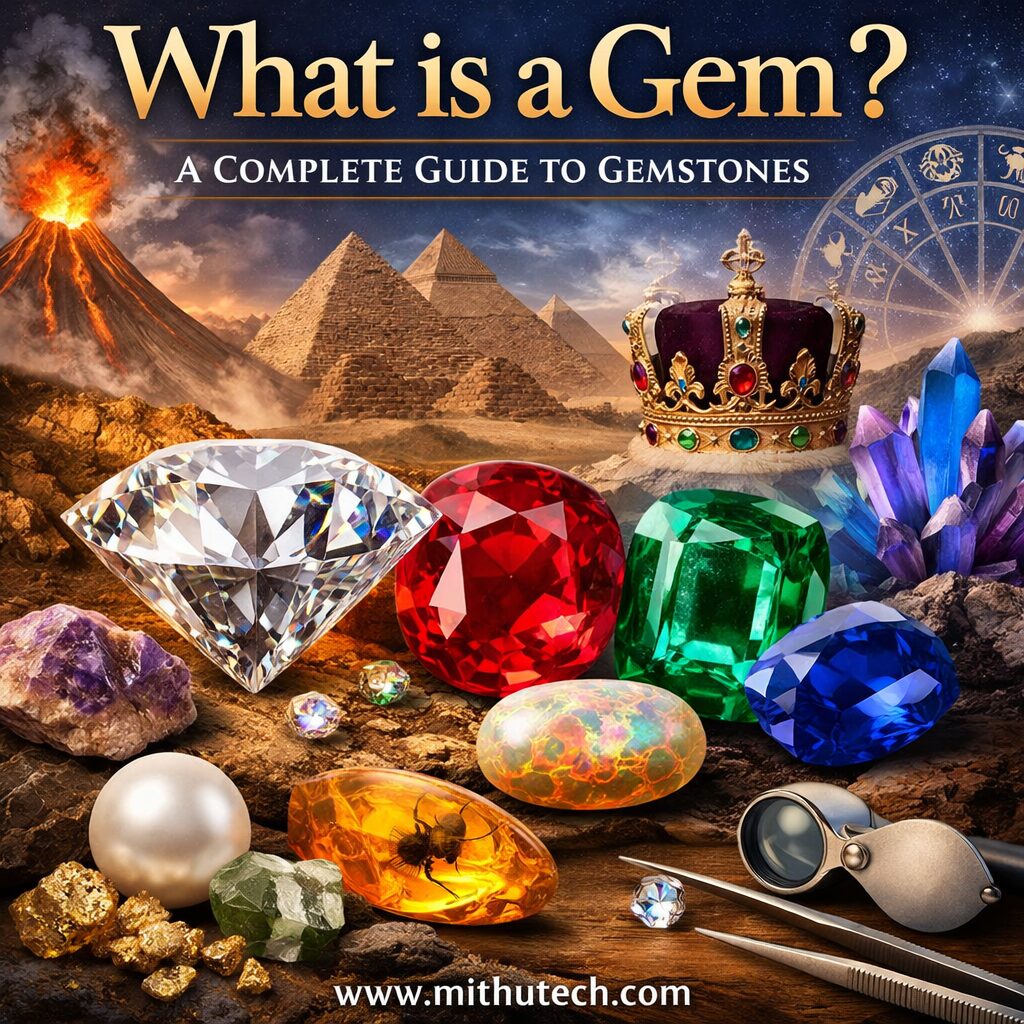
What is a gem? Explore the complete meaning of gemstones, their types, formation, properties, history, cultural importance, scientific classification, and modern uses in this detailed, SEO-friendly guide designed to rank on Google.
Introduction: Understanding the True Meaning of a Gem
The word “gem” carries a sense of beauty, rarity, and timeless value. From ancient civilizations to modern luxury markets, gems have fascinated humanity for thousands of years. But what exactly is a gem? Is it merely a shiny stone, or does it represent something deeper—scientifically, culturally, and economically?
A gem, also known as a gemstone, is a naturally occurring mineral or organic material that is cut, polished, and used primarily in jewelry and decorative arts. However, this simple definition barely scratches the surface. Gems are geological marvels, cultural symbols, investment assets, and even spiritual tools.
This comprehensive guide explores what a gem is, how it forms, its classifications, physical and optical properties, historical importance, and modern relevance. Whether you are a student, jewelry enthusiast, gemstone trader, or content creator, this article will give you authoritative and SEO-optimized knowledge.
What Is a Gem? – A Clear and Scientific Definition
A gem is a material—usually a mineral—that possesses three core qualities:
- Beauty – Visual appeal such as color, brilliance, transparency, or special optical effects
- Durability – Resistance to scratching, breaking, and chemical damage
- Rarity – Limited natural availability, which enhances value
In geology, most gems are crystalline minerals like diamond, ruby, sapphire, emerald, and topaz. Some gems, however, are organic in origin, such as pearls, amber, coral, and jet.
Only when a mineral meets these criteria and is skillfully cut and polished does it earn the status of a gemstone.
Difference Between Gemstones, Minerals, and Rocks
To fully understand gems, it is important to distinguish between related terms:
Mineral
A naturally occurring, inorganic substance with a defined chemical composition and crystal structure.
Rock
A solid aggregate of one or more minerals.
Gemstone
A mineral (or organic material) that is rare, beautiful, durable, and suitable for ornamental use.
Example:
Quartz is a common mineral, but when it forms as amethyst or citrine, it becomes a gemstone.
How Are Gems Formed? – The Geological Process
Gems form deep within the Earth through complex geological processes that take millions of years. The main formation processes include:
1. Igneous Formation
Gems crystallize from molten magma as it cools slowly beneath the Earth’s surface.
Examples: Diamond, peridot, spinel
2. Metamorphic Formation
Extreme heat and pressure transform existing minerals into new gemstone varieties.
Examples: Ruby, sapphire, emerald
3. Sedimentary Formation
Gems form through erosion, deposition, and chemical reactions over time.
Examples: Opal, turquoise, malachite
4. Organic Formation
Created by living organisms rather than geological processes.
Examples: Pearl (formed inside mollusks), amber (fossilized tree resin)
Types of Gems: Major Classifications
1. Precious Gemstones
Traditionally, only four gemstones are classified as precious:
- Diamond
- Ruby
- Sapphire
- Emerald
These gems are prized for exceptional hardness, brilliance, and rarity.
2. Semi-Precious Gemstones
All other gemstones fall into this category, including:
- Amethyst
- Topaz
- Garnet
- Aquamarine
- Tourmaline
- Peridot
Despite the name, many semi-precious gems can be rarer and more valuable than precious ones.
Organic vs Inorganic Gems
Inorganic Gems
Formed from minerals through geological processes.
Examples: Diamond, ruby, sapphire
Organic Gems
Derived from biological processes.
Examples: Pearl, coral, amber, jet
Physical Properties of Gems
1. Hardness (Mohs Scale)
Hardness measures resistance to scratching. The Mohs scale ranges from 1 to 10.
- Talc – 1
- Quartz – 7
- Topaz – 8
- Sapphire & Ruby – 9
- Diamond – 10
Harder gems are more suitable for daily-wear jewelry.
2. Color
Color is the most visually striking feature of a gem. It depends on chemical composition and trace elements.
- Chromium → Red (Ruby)
- Iron → Green (Emerald)
- Titanium + Iron → Blue (Sapphire)
Color includes hue, tone, and saturation.
3. Clarity
Clarity refers to internal inclusions or surface blemishes. Fewer inclusions usually mean higher value, except in gems like emerald, where inclusions are expected.
4. Cut
The cut determines how well a gemstone reflects light. A well-cut gem maximizes brilliance, fire, and scintillation.
5. Carat Weight
Carat measures weight, not size.
1 carat = 200 milligrams
Larger gems increase exponentially in value.
Optical Properties of Gemstones
Gems are admired for unique optical effects:
- Brilliance – White light reflection
- Fire – Dispersion of light into colors
- Luster – Surface shine
- Pleochroism – Different colors from different angles
- Asterism – Star effect (star sapphire)
- Chatoyancy – Cat’s eye effect
Popular Gemstones and Their Meanings
Diamond
Symbol of purity, strength, and eternal love.
Ruby
Represents passion, courage, and vitality.
Sapphire
Associated with wisdom, loyalty, and royalty.
Emerald
Symbol of rebirth, growth, and prosperity.
Amethyst
Linked to peace, protection, and mental clarity.
Historical Importance of Gems
Gems have played a vital role in human history:
- Ancient Egyptians used gems for protection and burial rituals
- Indian civilization linked gems with astrology and planetary powers
- European royalty used gems to symbolize authority
- Chinese culture valued jade for purity and immortality
Gems were once believed to cure diseases, ward off evil, and bring fortune.
Gems in Astrology and Spirituality
In Vedic astrology, gemstones are associated with planets:
- Ruby – Sun
- Pearl – Moon
- Emerald – Mercury
- Yellow Sapphire – Jupiter
- Diamond – Venus
- Blue Sapphire – Saturn
These gems are believed to influence energy, destiny, and mental balance when worn correctly.
Natural, Synthetic, and Imitation Gems
Natural Gems
Formed naturally in the Earth.
Synthetic Gems
Lab-created but chemically identical to natural gems.
Imitation Gems
Look similar but have different chemical properties (e.g., glass).
Understanding this difference is essential for buyers and investors.
Gemstone Mining: Where Do Gems Come From?
Major gemstone-producing countries include:
- India – Sapphire, emerald
- Sri Lanka – Sapphire, ruby
- Myanmar – Ruby
- Brazil – Amethyst, topaz
- South Africa – Diamond
- Colombia – Emerald
Mining methods range from traditional hand tools to advanced industrial extraction.
Modern Uses of Gems Beyond Jewelry
Gems are not limited to ornaments:
- Diamonds used in cutting tools and electronics
- Quartz used in watches and technology
- Sapphire used in smartphone screens and optics
- Garnet used as industrial abrasives
How to Identify a Genuine Gem
Key identification methods include:
- Visual inspection
- Hardness testing
- Refractive index measurement
- Certification from gemological labs (GIA, IGI, GII)
Professional testing ensures authenticity and value.
Gemstone Certification and Grading
Reputed gem labs issue certificates detailing:
- Gem type
- Origin
- Treatments
- Weight and dimensions
- Quality grading
Certified gems have higher market trust.
Investment Value of Gems
High-quality gems are considered alternative investments due to:
- Limited supply
- Long-term value appreciation
- Global demand
Diamonds, rubies, and emeralds are especially popular among investors.
Caring and Maintaining Gemstones
- Clean gently with mild soap and water
- Avoid harsh chemicals
- Store separately to prevent scratches
- Regular professional inspection
Proper care preserves brilliance and longevity.
The Future of the Gem Industry
With advancements in technology, ethical sourcing, and lab-grown gems, the gemstone industry is evolving rapidly. Transparency, sustainability, and innovation are shaping the future market.
Conclusion: Why Gems Will Always Be Valuable
A gem is far more than a beautiful stone. It is a product of nature’s patience, human craftsmanship, cultural belief, and scientific wonder. From ancient rituals to modern investments, gems continue to hold unmatched significance.
Understanding what a gem is empowers buyers, learners, and enthusiasts to appreciate its true worth—not just in price, but in history, science, and symbolism.
Below is a fully written Question–Answer FAQ section (70 FAQs) with clear, concise, SEO-optimized answers. You can directly paste this section into your article to improve search visibility, dwell time, and Google featured-snippet eligibility.
Frequently Asked Questions (FAQs) About Gems and Gemstones
1. What is a gem?
A gem is a naturally occurring mineral or organic material that is rare, durable, and beautiful enough to be cut and polished for use in jewelry or decorative purposes.
2. What is a gemstone?
A gemstone is a refined form of a gem that has been cut and polished to enhance its appearance and value.
3. Are gem and gemstone the same?
Yes, both terms are commonly used interchangeably, although “gemstone” is the more formal and commercial term.
4. What makes a stone a gem?
A stone becomes a gem when it has beauty, rarity, durability, and the ability to take a good polish.
5. Are all gems minerals?
Most gems are minerals, but some gems like pearls and amber are organic in origin.
6. What are precious gemstones?
Precious gemstones traditionally include diamond, ruby, sapphire, and emerald.
7. What are semi-precious gemstones?
All gemstones other than the four precious ones are classified as semi-precious, such as amethyst, garnet, and topaz.
8. Are semi-precious gems less valuable?
Not always. Some semi-precious gemstones are rarer and more expensive than precious ones.
9. What is the rarest gemstone in the world?
Painite is considered one of the rarest gemstones ever discovered.
10. Which gemstone is the hardest?
Diamond is the hardest gemstone, ranking 10 on the Mohs hardness scale.
11. How are gemstones formed?
Gemstones form deep inside the Earth through heat, pressure, and chemical reactions over millions of years.
12. How long does it take for a gem to form?
Most gemstones take millions to billions of years to form naturally.
13. Where are gemstones found?
Gemstones are found in specific geological environments across countries like India, Sri Lanka, Brazil, Myanmar, and South Africa.
14. Are gemstones found in India?
Yes, India is known for sapphire, ruby, emerald, and many semi-precious gemstones.
15. Can gemstones be found in rivers?
Yes, alluvial gemstones like diamonds and sapphires are often found in riverbeds.
16. What is gemstone hardness?
Hardness measures a gem’s resistance to scratching and is determined using the Mohs scale.
17. What is the Mohs scale?
The Mohs scale ranks minerals from 1 to 10 based on their hardness.
18. What does carat mean in gemstones?
Carat refers to the weight of a gemstone, where 1 carat equals 200 milligrams.
19. Does higher carat mean higher value?
Not always. Color, clarity, cut, and rarity also affect gemstone value.
20. What gives gemstones their color?
Trace elements and impurities in the crystal structure give gemstones their unique colors.
21. What is gemstone clarity?
Clarity refers to the presence or absence of internal inclusions and surface flaws.
22. What is gemstone cut?
Cut determines how well a gemstone reflects light and enhances brilliance.
23. What is brilliance in gemstones?
Brilliance is the reflection of white light from a gemstone’s surface and interior.
24. What is fire in gemstones?
Fire is the dispersion of light into rainbow colors within a gemstone.
25. What are natural gemstones?
Natural gemstones are formed in the Earth without human intervention.
26. What are synthetic gemstones?
Synthetic gemstones are lab-created but have the same chemical and physical properties as natural gems.
27. Are lab-grown gemstones real?
Yes, lab-grown gemstones are real but are not naturally formed.
28. What are imitation gemstones?
Imitation gemstones look like real gems but are made from glass or other materials.
29. How can you identify a real gemstone?
Authentic gemstones are identified through professional gem testing and certification.
30. Are gemstone treatments common?
Yes, treatments like heating and oiling are commonly used to enhance appearance.
31. Are treated gemstones natural?
Yes, treated gemstones are still natural but have undergone enhancement.
32. What is gemstone certification?
Certification is a laboratory report that verifies a gemstone’s authenticity and quality.
33. Why is gemstone certification important?
It ensures trust, transparency, and accurate valuation.
34. What is the use of gemstones in astrology?
Gemstones are believed to balance planetary energies and improve life aspects.
35. Which gemstone is best for astrology?
The best gemstone depends on a person’s birth chart and planetary positions.
36. Can anyone wear gemstones?
Yes, but astrologically recommended gemstones should be worn after expert advice.
37. What is Navratna?
Navratna is a combination of nine gemstones representing nine planets.
38. Do gemstones have healing powers?
While not scientifically proven, many believe gems influence emotional and spiritual well-being.
39. Are gemstones used in modern technology?
Yes, diamonds, quartz, and sapphires are widely used in technology and industry.
40. Why is diamond used in tools?
Because diamond is extremely hard and durable.
41. Are gemstones good for investment?
High-quality and rare gemstones can be good long-term investments.
42. Which gemstones are best for investment?
Diamonds, rubies, emeralds, and sapphires are most popular for investment.
43. Can gemstone value increase over time?
Yes, rarity and demand can increase a gemstone’s value.
44. Is gemstone resale easy?
Resale depends on quality, certification, and market demand.
45. How should gemstones be cleaned?
Use mild soap, lukewarm water, and a soft brush.
46. Can gemstones lose shine?
Yes, improper care and daily wear can dull gemstones.
47. Can gemstones break?
Some gemstones can crack or chip if hit or mishandled.
48. How should gemstones be stored?
Store gemstones separately in soft cloth or padded boxes.
49. How long do gemstones last?
With proper care, gemstones can last for generations.
50. Why are gemstones timeless?
Because they combine natural beauty, rarity, cultural value, and enduring appeal.
Discover more from Mithu Tech Group
Subscribe to get the latest posts sent to your email.